← Home · Ground improvement

Stone Column Design & Ground Improvement in Drogheda

Together, we solve the challenges of tomorrow.

LEARN MORE →

The alluvial silts and soft clays of the Boyne River valley pose a real challenge for foundation engineering across Drogheda. Much of the town sits on these deep, compressible deposits where undrained shear strengths rarely exceed 25 kPa and settlement can drag on for months without ground treatment. Stone column design becomes the practical answer when you need to support embankments, industrial slabs, or low-to-mid-rise structures without resorting to deep piling. Our approach combines site-specific CPT testing to map the soft zones with precision, and we often run a grain size analysis beforehand to confirm the host soil matrix will drain properly around the stone. From the retail parks near the M1 to the housing schemes west of the railway, we have seen how well-designed vibro-replacement transforms otherwise unbuildable ground into a competent bearing stratum.

A well-designed stone column grid typically reduces total settlement by 50 to 70 percent in the soft Boyne alluvium — numbers we verify with post-treatment CPT every time.

Methodology and scope

Ground conditions shift noticeably between the northern terrace gravels and the southern floodplain clays. Around the town centre, you get stiff glacial tills at moderate depth, which can limit column penetration and favour a floating stone column approach. Cross the river toward the Donore Road industrial estates, and the soft estuarine silts run deeper, often demanding full-depth columns with a stronger load transfer platform. For these variable profiles, experience with in-situ permeability testing helps us verify that the stone drains will actually dissipate excess pore pressure after installation. Key features of the service include:
Stone Column Design & Ground Improvement in Drogheda
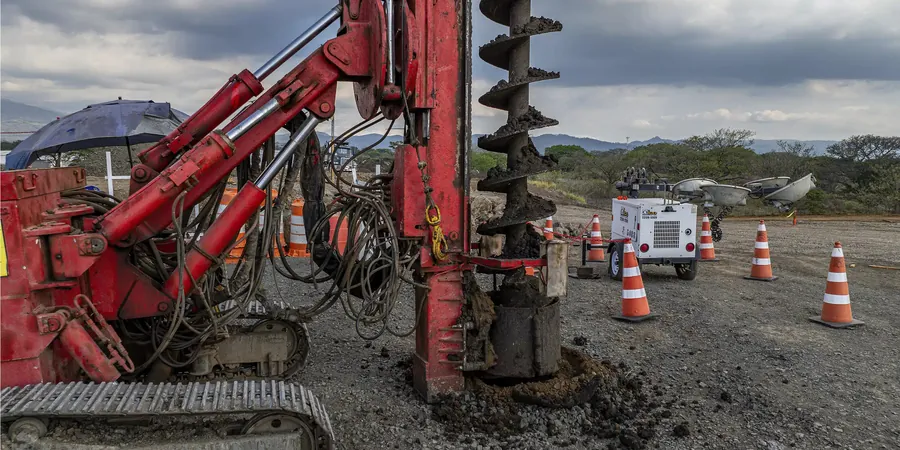
Technical reference image — Drogheda

Local considerations

One thing we notice repeatedly in Drogheda is how groundwater levels in the floodplain sit barely a metre below ground surface during winter. If you ignore that and try to install stone columns without proper backfill controls, the hole collapses before the stone locks in, leaving soft inclusions that become settlement hotspots later. Another local pitfall is underestimating the lateral extent of the soft zone: a column field that stops short of the property boundary can create a differential settlement step where the untreated soil outside compresses more. We always recommend a buffer row or a transition zone at the edges. And in areas with historical fill near the old port, it pays to run a test pit investigation first to rule out buried organics or debris that would compromise column integrity.

Need a geotechnical assessment?

Reply within 24h.

Email: contact@geotechnical-engineering.co

Technical parameters

ParameterTypical value
Design codeIS EN 1997-1:2005 (Eurocode 7)
Column diameter600 mm to 1000 mm typical
Maximum treatment depth8 m (extendable with pre-drilling)
Area replacement ratio10% to 30% depending on load
Aggregate specificationClean crushed stone, 25-75 mm, per BRE BR 391
Post-treatment verificationZone load tests, CPT, or plate load tests
Settlement reduction factorn = 2 to 4 under working loads
Installation methodWet or dry bottom-feed vibroflot

Associated technical services

01

Vibro-replacement design and installation

Full design of stone column grids for bearing capacity and settlement control, including choice of wet or dry bottom-feed method depending on groundwater conditions and soil sensitivity. Installation monitored in real time with ammeter and depth logs.

02

Post-treatment verification testing

We run zone load tests, CPT profiles between columns, and plate load tests to confirm the stiffness improvement factor meets the design assumptions. All results benchmarked against IS EN 1997-1 serviceability limits.

Applicable standards

IS EN 1997-1:2005 (Eurocode 7, Geotechnical design), BRE BR 391 (Specifying vibro stone columns), IS EN 14731:2005 (Execution of special geotechnical works — ground treatment by deep vibration), IS EN 932 (Tests for general properties of aggregates)

Frequently asked questions

How much does stone column design and installation cost for a typical Drogheda site?

For a standard commercial or residential site in the Drogheda area, stone column packages typically run between €1.270 and €4.750, depending on the treated area, column depth, and whether you need a load transfer platform. A small house plot with shallow treatment will sit at the lower end; an industrial slab over deep Boyne silts with extensive verification testing will push toward the upper range.

How do you know if stone columns will work in Drogheda's alluvial silts?

The key is the fines content and the undrained shear strength of the host soil. We run CPT soundings and take samples to check that the silt has enough cohesion to confine the stone column laterally. As long as the undrained shear strength is above roughly 15 kPa, vibro-replacement can deliver reliable improvement. For borderline cases we may recommend a trial column with a zone load test before committing to the full grid.

What verification do you provide after the stone columns are installed?

Post-treatment verification in Drogheda usually consists of CPT soundings at the centroid of a column triangle, plus one or two zone load tests on isolated columns. We compare the post-treatment cone resistance to the pre-treatment baseline to calculate the stiffness improvement factor and confirm settlement reduction. A short report with all correlations and Eurocode 7 serviceability checks is delivered within two weeks of testing.
Location and service area

We serve projects across Drogheda and its metropolitan area.

View larger map