← Home · Laboratory

Grain Size Analysis (Sieve + Hydrometer) in Drogheda

Together, we solve the challenges of tomorrow.

LEARN MORE →

In Drogheda we keep running into the same issue on Boyne Valley sites: a visual log says one thing, but the grain size curve tells a completely different story. That silt layer at 2.5 metres depth looks harmless until the hydrometer picks up 35% clay fraction. At that point, settlement predictions change. Drainage assumptions fail. We run the full hydrometer on every sample from the alluvial flats between the Boyne and the N1—it is the only way to separate true silt from active clay. Some labs stop at the #200 sieve. We do not. For atterberg limits we need the clay fraction first, so the combined sieve-plus-hydrometer becomes the backbone of every classification package we issue for Drogheda projects.

A sieve-only result on Boyne alluvium is half the picture. The hydrometer tells you what your foundation actually sits on.

Methodology and scope

Drogheda sits at roughly 53.715°N, where the Boyne estuary deposits create layered sequences of sand, silt, and occasional peat pockets. A clean sand lens at 4 metres can be underlain by high-plasticity clay within the same borehole. The combined grain size analysis covers the full range: coarse fraction by sieve stack from 75 mm down to 75 µm, fine fraction by hydrometer using ASTM D422 / D6913 procedures. We run dispersing agent checks on every sample because the calcareous fines common in the area flocculate easily in distilled water. For road base materials sourced from local quarries near Tullyallen, the gradation curve determines compliance with TII Specification for Road Works Series 600. On a recent warehouse pad near Donore Road, the hydrometer caught 28% sub-75 µm material that the contractor had assumed was free-draining sand—the proctor tests later confirmed the moisture sensitivity.
Grain Size Analysis (Sieve + Hydrometer) in Drogheda
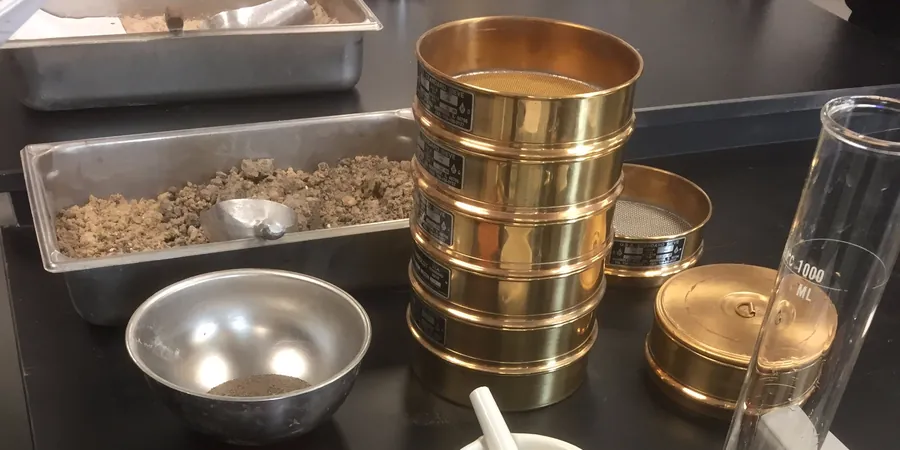
Technical reference image — Drogheda

Local considerations

The north-side estates on higher ground sit on glacial till—dense, gravelly, well-graded. Move south toward the Marsh Road retail parks and you are on soft estuarine silts where the gradation curve shifts entirely into fine territory. We have seen two adjacent sites on the same street produce D10 values an order of magnitude apart. Undersizing the drainage layer because someone assumed uniform sand is the most expensive mistake we correct in Drogheda. A proper grain size curve gives you the filter compatibility check between subgrade and drainage aggregate. Skip it, and the fines migrate into the stone, clog the system, and the pavement fails. The hydrometer step adds maybe two days to the lab schedule. Replacing a failed sub-base costs months.

Need a geotechnical assessment?

Reply within 24h.

Email: contact@geotechnical-engineering.co

Technical parameters

ParameterTypical value
Sieve range75 mm to 75 µm (ASTM E11 sieves)
Hydrometer methodASTM D422 / D6913 (152H hydrometer)
DispersantSodium hexametaphosphate, concentration adjusted for calcareous soils
Minimum sample mass500 g for fine-grained, 5 kg for granular
Reporting parametersD10, D30, D60, Cu, Cc, % gravel/sand/silt/clay
AccreditationINAB to ISO 17025

Associated technical services

01

Combined Sieve + Hydrometer (Full Curve)

One test, one report, one continuous particle size distribution from gravel down to clay colloids. We wash the sample over a 75 µm sieve, oven-dry both fractions, run the coarse stack and the fine hydrometer, then splice the curves at 75 µm. This is the default for foundation investigations where classification to BS EN ISO 14688 is required.

02

Rapid Washed Sieve (Granular Soils)

For clean sands and gravels with less than 5% fines, a washed sieve analysis without hydrometer delivers the gradation in 24 hours. Suitable for concrete aggregate checks, drainage blanket specification, and filter material verification.

Applicable standards

ASTM D422-63 (2007) – Standard Test Method for Particle-Size Analysis of Soils, ASTM D6913/D6913M-17 – Sieve Analysis, IS EN ISO 17892-4:2016 – Geotechnical investigation, laboratory testing, particle size distribution, TII Specification for Road Works, Series 600
Frequently asked questions

What is the typical cost for a combined sieve and hydrometer analysis in Drogheda?

For a single sample, expect between €110 and €160, depending on whether the hydrometer is required and how many sieves are in the stack. Volume pricing applies for five or more samples from the same borehole.

Why does the hydrometer test take longer than a simple sieve?

The hydrometer relies on Stokes’ law—particles settle at different rates in a fluid column based on their diameter. We take readings at timed intervals over 24 hours to accurately capture the silt-to-clay boundary. The calcareous fines common in Drogheda’s estuarine deposits require careful dispersant checks, which adds a few hours to the preparation stage.

How do I sample soil for a grain size analysis on a Drogheda site?

Disturbed samples in sealed plastic bags are fine for grain size work. We need about 1 kg for fine-grained soils and up to 5 kg for granular materials. Keep the bag labelled with depth and borehole ID. Avoid drying the sample in direct sun—the natural moisture helps with dispersion during the hydrometer prep.

Location and service area

We serve projects across Drogheda and its metropolitan area.

View larger map