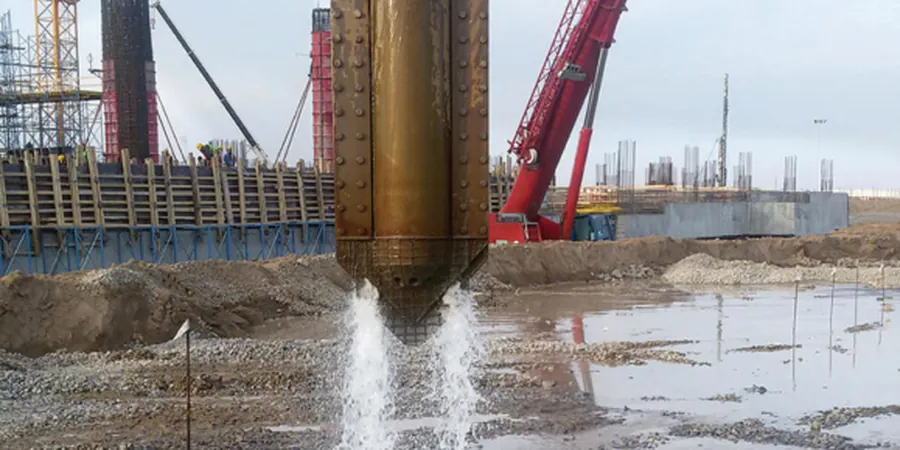
When borehole logs across Drogheda show loose-to-medium dense sands at depths of 3 to 12 meters, the reflex should not be over-excavation. The Boyne estuary corridor and the terraced gravels south of the river hide compressible layers that compact unevenly under load, and that is where vibrocompaction design shifts from an option to the most cost-effective solution. Our team sizes the grid, selects the vibrator horsepower and frequency, and defines the target relative density, all tied to the SPT-N or CPT tip resistance the finished floor slab or raft actually needs. We cross-check the design with CPT testing to calibrate the pre- and post-treatment profiles and with grain-size analysis to confirm the soil falls within the compactable range before a single rig arrives on site.
A well-designed vibrocompaction grid can turn loose estuarine sand into a bearing stratum capable of 250 kPa without importing a single ton of stone.
Local considerations
The most expensive mistake we see in Drogheda is a contractor signing off on a vibrocompaction subgrade without independent post-treatment verification. A few poorly compacted columns or a vibrator frequency set too low leaves soft pockets that cause differential settlement under a warehouse floor slab, and by then the steel frame is already up and the cost to repair is ten times the price of a verification CPT. Another risk is applying the technique to silty sands with fines content above 25 percent: the pore pressure does not dissipate fast enough, the sand liquefies locally during vibration, and the density gain disappears within weeks. We design the drainage pauses and the phased energy input to avoid that, and we tie the acceptance criteria to a minimum CPT tip resistance of 10 MPa or an SPT N60 above 20 blows, measured two weeks after the final pass.
Applicable standards
EN 14731:2005 – Execution of special geotechnical works – Ground treatment by deep vibration, IS EN 1997-1:2005 (Eurocode 7) – Geotechnical design, with Irish National Annex, ICE Specification for Ground Treatment (UK, adopted in Irish practice), ASTM D6066-11 – Standard Practice for Determining the Normalized Penetration Resistance of Sands (used for liquefaction check), BS 812 / IS EN 933 – Particle size and fines content determination
Frequently asked questions
What does vibrocompaction design typically cost for Drogheda sites?
For a Drogheda project, the design-only scope—including feasibility analysis, grid layout, method statement, and verification specification—ranges from €1,240 to €4,330 depending on site area and the volume of existing investigation data we need to process. Site investigation, the compaction rig, and verification testing are separate costs that we help you specify and tender.
How do you know if the soil under my Drogheda site is suitable for vibrocompaction?
We need grain-size curves from at least three boreholes across the footprint. The key number is the fines content passing the 63-micron sieve. Below 15 percent, pure vibrocompaction works well. Between 15 and 25 percent, we design with shorter probe spacing and allow drainage pauses. Above 25 percent, we usually recommend stone columns or a different technique.
How close to existing buildings can vibrocompaction be done in Drogheda?
We set an exclusion zone based on peak particle velocity limits, usually 0.5 to 1.0 mm/s for masonry buildings. In Drogheda's historic centre, that often means a buffer of 8 to 15 metres depending on the vibrator power. We specify vibration monitoring with triaxial geophones on the nearest structure and adjust the energy level if thresholds are approached.
What verification is required after vibrocompaction in Ireland?
Following EN 14731 and Eurocode 7, we specify post-treatment CPT or SPT testing at a minimum of one test per 200 square metres, performed no sooner than two weeks after the final pass. The acceptance criterion is typically a CPT tip resistance of 10 MPa or an SPT N60 above 20 blows across the treated depth. We deliver a before-and-after comparison report for the design team and the local authority.