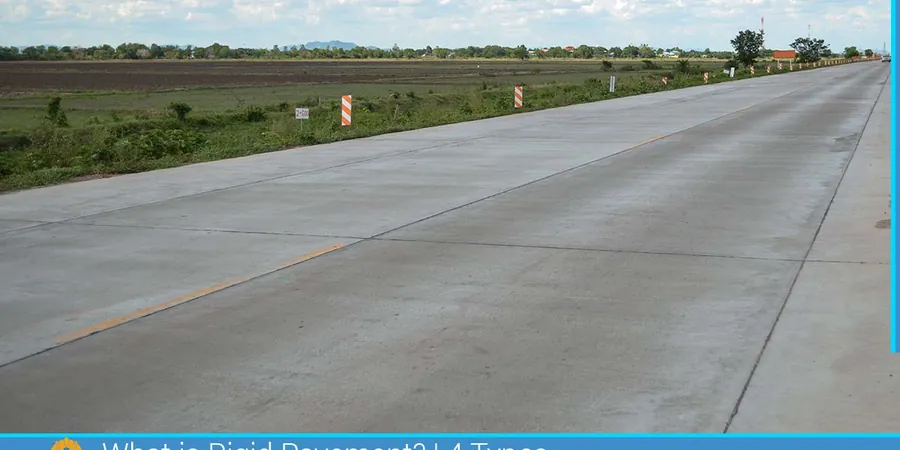
Specifying a rigid pavement without a site-specific subgrade assessment in Drogheda nearly always ends the same way: curling cracks at slab corners within the first three winters and pumping fines at the longitudinal joint after eighteen months of HGV traffic. The till-derived soils across the Boyne valley look uniform on a desk study but vary from stiff gravelly clay on the north side to soft alluvial silts near the quays, and a standard 150 mm Type 1 sub-base simply does not perform the same way across both. Our laboratory team runs the full suite — moisture-conditioned CBR, one-dimensional consolidation on Shelby tubes, and plate load tests to derive the modulus of subgrade reaction — because the Westergaard equations need real numbers, not textbook assumptions. When the pavement will serve a distribution centre off the Donore Road or a bus depot near the M1 interchange, we also cross-check the CBR road design parameters so the subbase thickness is calibrated to the actual soaked strength of the formation, not a conservative guess that blows the earthworks budget.
A rigid pavement design that ignores the seasonal moisture variation in the subgrade will exhibit pumping and corner breaks within the first five years of service, regardless of the concrete flexural strength.
Local considerations
The risk profile for a rigid pavement on the north side of Drogheda — say, the industrial estates near the M1 retail park — versus a site on the south bank close to the Mary Street quays could not be more different. The northern sites sit on lodgement till with a natural moisture content within 2% of the plastic limit; drainage is predictable, and the long-term k-value stays within a narrow band. Down by the river, the post-glacial alluvium contains organic lenses and peat pockets less than 300 mm thick that are easily missed by a widely spaced borehole grid, yet they create differential settlement of 15–25 mm across a single slab panel. That is enough to initiate pumping at the transverse joint under repeated 11.5-tonne axle loads, and once water and fines start migrating, the void beneath the slab doubles in area every wet season. A combined test pits investigation at 15-metre centres plus a falling-head permeability test in each logged layer is the minimum we recommend before finalising the joint spacing and the dowel bar diameter for any pavement within 200 metres of the Boyne's mapped floodplain.
Frequently asked questions
What subgrade investigation depth is required for a rigid pavement design in Drogheda?
We probe to a minimum depth of 1.5 times the radius of relative stiffness below the formation level, which for a 250 mm slab on a k-value of 54 MPa/m typically means 1.8–2.5 metres. In the alluvial zones south of the Boyne we extend to 4 metres to capture any buried organic layers that would cause long-term differential settlement.
How does the local limestone aggregate affect the concrete's thermal behaviour?
The Carboniferous limestone quarried near Drogheda has a coefficient of thermal expansion between 8 and 10 × 10⁻⁶ per degree Celsius, which is lower than granite or basalt. That reduces the curling stress for a given temperature gradient, and we verify this with laboratory CTE tests on the actual blend proposed by the ready-mix supplier.
What is the typical cost range for a rigid pavement geotechnical investigation in Drogheda?
A complete investigation covering dynamic cone testing, plate load tests, laboratory CBR and resilient modulus, plus the concrete durability suite generally falls between €1.840 and €5.460, depending on the pavement footprint area and the number of test locations required.
Which joint spacing do you recommend for industrial yards on Drogheda till soils?
For the stiff gravelly till on the north side we typically design for 4.5–5.0 metre square panels with dowelled contraction joints. Where the subgrade transitions to softer alluvium near the river we reduce the spacing to 3.5 metres and add a tied concrete shoulder to control transverse cracking from differential heave.