Drogheda’s layered history runs deep—literally. Millennia of trade along the River Boyne left a complex urban geology, where medieval foundations sit atop soft estuarine silts and dense glacial tills. Every redevelopment project between West Street and the old port encounters this unpredictable ground. A single borehole can miss a loose lens of alluvium that undermines an entire bearing capacity calculation. That’s exactly why a CPT test delivers sharper data. The cone penetrates continuously, mapping the thin seams that define Drogheda’s subsurface, from the compact sands near the M1 crossing to the compressible clays around the docks. When stratigraphy shifts within meters, the cone doesn’t guess—it measures tip resistance and sleeve friction in real time. Before you commit to piling depths, combine the CPT profile with spt drilling for disturbed sample recovery where it adds value.
Continuous cone data reveals the thin compressible seams that Drogheda’s estuarine geology hides between denser layers—boreholes miss them, CPT does not.
Local considerations
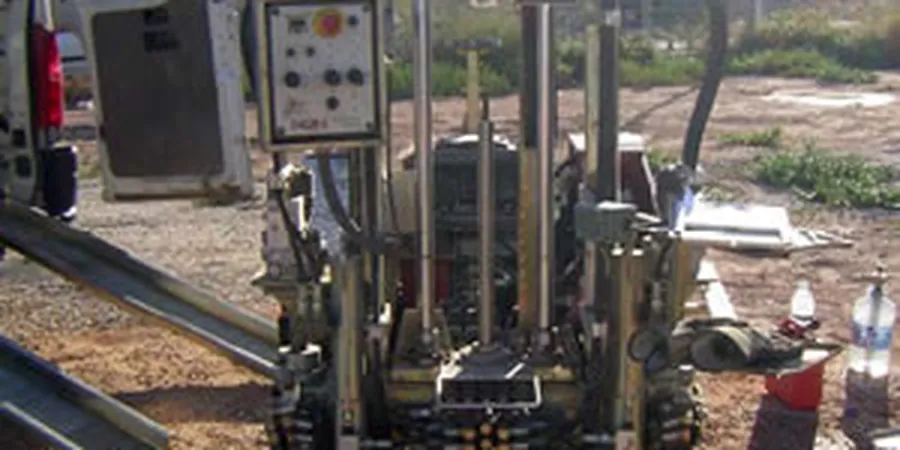
The 20-tonne truck-mounted CPT rig looks like a mobile drilling platform, but it works on a fundamentally different principle—pure static push, no rotation, no hammering. A hydraulic ram drives the cone string into the ground at precisely 2 cm per second. The reaction mass comes from the truck’s own weight plus screw anchors deployed into the soil. On Drogheda’s soft alluvial sites, the limiting factor is rarely the rig’s capacity; it’s the risk of pushing the truck upward if the anchors can’t bite. That happens when the surface crust is thin and the silt below offers minimal grip. We counter it by increasing anchor depth or deploying a tracked rig with lower ground pressure. The real hazard is refusal on cobble beds within the glacial sequence—the cone tip hits a boulder, the rod bends, and the test stops. Knowing where to expect refusal takes local experience of the Boyne Valley’s erratic drift distribution.
Frequently asked questions
How much does a CPT test cost in Drogheda?
A typical CPT profile in the Drogheda area runs between €160 and €230 per test, depending on depth achieved and whether piezocone or seismic add-ons are required. Soft alluvial sites that allow deep penetration without refusal fall at the lower end; sites with early refusal on till or cobbles may need multiple attempts, which affects total cost. We provide a fixed quote after reviewing your site location and target depth.
What depth can CPT reach in Drogheda’s ground?
In the soft silts and sands along the Boyne corridor, we routinely reach 20 to 25 meters below ground level with a 20-tonne rig. On the higher terraces where dense lodgement till dominates, refusal typically occurs between 10 and 15 meters. The exact refusal depth depends on the cobble content and the degree of overconsolidation of the till.
Does CPT replace boreholes for foundation design?
CPT provides continuous soil behaviour data that boreholes cannot match, but it does not recover physical samples. For Drogheda projects, we recommend combining CPT profiling with a limited number of boreholes or test pits where soil classification needs laboratory verification or where environmental samples are required. The two methods are complementary.
Is CPT suitable for the soft ground near the River Boyne?
Yes—in fact, CPT excels in Drogheda’s soft estuarine deposits. The cone tip measures very low undrained shear strengths (down to 5–10 kPa) with high resolution, and the pore pressure sensor captures the slow dissipation that governs consolidation settlement. Standard penetration testing in these materials often yields zero blow counts, giving no useful data.
How fast do you deliver CPT results?
We provide preliminary soil behaviour type logs on site immediately after each test. The final interpreted report, including corrected parameters and engineering recommendations, is delivered within two working days. For urgent foundation decisions, we can fast-track the report to 24 hours.