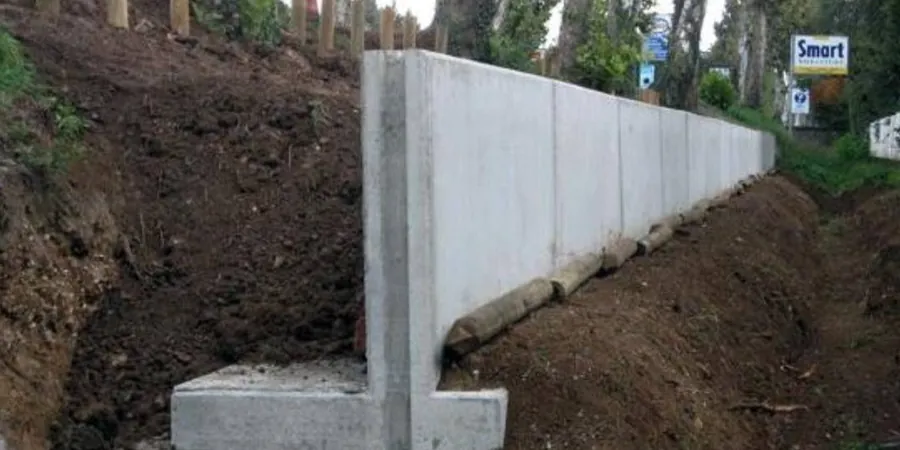
The lower banks of the River Boyne in Drogheda present a classic geotechnical challenge: up to 8 metres of soft alluvial silts overlying dense, stony glacial till. Groundwater sits barely 2 metres below street level along the quays, which means any excavation deeper than a domestic basement is working against hydrostatic pressure from the start. A retaining wall design in this town has to account for more than just retained height — it must handle rapid drawdown conditions after heavy rainfall and the long-term creep of the underlying boulder clay. The team has pulled together data from local site investigations, including borehole logs near the Marsh Road area, to calibrate drained and undrained parameters that actually reflect Drogheda's subsurface rather than generic textbook values.
When the ground profile gets complicated across a single site, we often pair the retaining wall analysis with a slope stability assessment to check global failure mechanisms, especially where the excavation face cuts through layered deposits.
In Drogheda's alluvium, the difference between a working wall and a costly failure often comes down to the drainage design behind the stem.
Methodology and scope
Drogheda's growth since the early 2000s has pushed development onto marginal land north of the river, where made ground and historic fill complicate the bearing stratum. The old port infrastructure left behind a patchwork of buried quay walls and timber piles, and any new retaining structure has to be designed around these obstructions without compromising the drainage path behind the wall. We run our designs through limit equilibrium and finite element software calibrated with site-specific shear strength data — effective friction angles in the till typically range from 32° to 36°, while the alluvium can drop to an undrained shear strength as low as 25 kPa in the worst pockets. For cantilever and propped walls, serviceability limit states govern in Drogheda more often than ultimate limit states, simply because the adjacent Georgian and Victorian buildings along West Street and Laurence Street have very little tolerance for lateral movement.
Frequently asked questions
What retaining wall types are suitable for Drogheda's soil conditions?
Most sites in Drogheda work well with reinforced concrete cantilever walls for heights under 4 metres, provided the foundation can bear on the glacial till. Where the alluvium is thicker — common near the river — embedded sheet pile or secant pile walls become more practical because they cut off groundwater and reduce the excavation footprint. Gravity walls in mass concrete or gabion can work for landscaping projects on the northern slopes where till is shallow and free-draining.
Do I need a site investigation before a retaining wall design?
Yes, and the Irish Building Regulations effectively require it. A retaining wall is a Category 2 structure under IS EN 1997, which means you need at least one borehole, trial pit, or CPT sounding within the wall footprint. In Drogheda we recommend a minimum of two investigation points for any wall longer than 20 metres because the alluvium-till interface can vary by over a metre across a single site.
How much does retaining wall design cost for a typical Drogheda project?
Design fees generally fall between €830 for a straightforward garden wall with good ground data already available, and €4,170 for a full basement or quay wall design involving finite element analysis, staged construction modeling, and coordination with the structural engineer. The range depends on wall height, ground complexity, and whether existing borehole data can be reused.
How long does the design and approval process take?
A well-scoped retaining wall design in Drogheda can be turned around in two to three weeks, assuming the ground investigation data is already in hand. If new boreholes or laboratory testing are required, add another three to four weeks for drilling, sampling, and triaxial or oedometer testing. The local authority typically reviews the design as part of the commencement notice process, which runs in parallel with the detailed engineering.