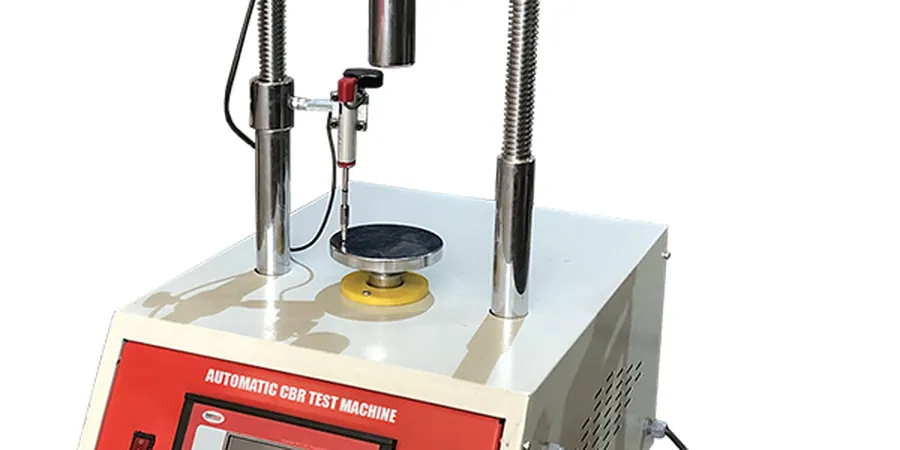
The ground beneath Drogheda tells two very different stories depending on which side of the Boyne you are building on. North of the river, near the old Millmount complex, glacial tills with good bearing capacity dominate the subgrade—compacted, dense, and generally predictable for pavement foundations. Cross south into the expanding residential zones around Bryanstown and the soil profile shifts to alluvial silts and soft clays deposited over centuries of river meandering. That contrast means a standard pavement section that works perfectly on the north bank can fail within three years on the south bank if the subgrade strength is not verified. The [laboratory CBR test](ensayo-cbr) quantifies this difference precisely, giving design engineers the soaked and unsoaked bearing values they need to size the pavement structure correctly. In a town where new link roads and housing estates are constantly pushing into marginal ground, skipping this test is a decision that comes back as premature rutting and costly resurfacing.
A soaked CBR value is not an academic number—it is the realistic strength of your subgrade after a wet Irish winter saturates the pavement foundation.
Methodology and scope
We recently completed a subgrade investigation for a distribution centre access road off the Donore Road industrial area. The contractor had assumed a design CBR of 5% based on a desk study, but site observations showed a silty clay layer at formation level that looked softer than expected. Three disturbed samples were taken at formation depth, sealed immediately to preserve natural moisture content, and compacted at the laboratory to the specified Proctor density before undergoing the CBR penetration test. The results came back at 2.8% CBR after four days of soaking—dramatically lower than the assumed value. That single data point triggered a redesign of the capping layer thickness, adding 300 mm of crushed rock before the sub-base could be placed. For projects where the subgrade is variable, combining the laboratory CBR with a [field CBR test](cbr-road) or dynamic cone penetration provides a more complete picture of in-situ strength. The laboratory portion, however, remains essential because it measures the material’s strength under controlled moisture and density conditions that replicate the worst-case scenario after construction.
Local considerations
The single most common mistake we see on Drogheda paving projects is using a CBR value obtained from a sample compacted at optimum moisture content without soaking. A contractor collects a few kilograms of subgrade, brings it to a lab, and gets a CBR of 8% or 10%—looks great on paper and the pavement design proceeds with a thin granular base. Eighteen months later, after two wet seasons, the subgrade beneath the pavement has absorbed moisture from the water table and from infiltration through cracked asphalt, and its actual in-situ CBR has dropped below 3%. The result is longitudinal cracking, edge deformation, and potholes that appear with alarming speed. BS 1377-4 requires the four-day soak precisely because it simulates this long-term moisture equilibrium. The cost difference between a properly soaked CBR test and an unsoaked quick test is trivial compared to the cost of reconstructing a failed pavement. For roads serving heavy commercial traffic—like the approach to Drogheda Port—this distinction is not academic; it determines whether the pavement reaches its design life or fails at half that.
Applicable standards
BS 1377-4:1990 – Soaked CBR determination for fine and granular soils, ASTM D1883-21 – Standard Test Method for California Bearing Ratio of Laboratory-Compacted Soils, TII CC-SPW-01200 – Transport Infrastructure Ireland specification for road pavement materials, IS EN 13286-47 – Unbound and hydraulically bound mixtures, CBR test method, NRA HD 26/06 – Pavement design guidance referencing CBR inputs
Frequently asked questions
How much does a laboratory CBR test cost in Drogheda?
A standard soaked CBR test on a single remoulded sample typically ranges from €110 to €220, depending on whether the compaction curve (Proctor) needs to be determined first and how many points are tested. We provide a fixed quote upfront so there are no surprises.
What’s the difference between a laboratory CBR and a field CBR test?
The laboratory CBR test is performed on a sample compacted to a target density and moisture content, then soaked for four days to simulate long-term saturation. It gives you the material’s potential strength under controlled conditions. A field CBR test measures the in-situ strength of the soil at its natural moisture and density, right there on the formation. Both are useful—the field test tells you what you have today, the lab test tells you what it will become after construction and seasonal wetting. For pavement design in Drogheda, the soaked lab value is the safer design parameter.
How long does it take to get CBR results from the laboratory?
The test itself requires a minimum of four days for the soaking phase, plus sample preparation and compaction time. Typical turnaround from sample receipt to certified report is five to seven working days. We can accommodate urgent requests for projects on tight schedules—contact us to discuss priority processing.
What soil types can be tested with the laboratory CBR method?
The method works for fine-grained soils (silts and clays) and granular soils with particle sizes up to 37.5 mm. For materials with larger particles, such as coarse crushed rock used in capping layers, the CBR mould diameter limits the maximum particle size. In those cases we advise on alternative approaches, such as plate bearing tests or in-situ density and stiffness measurements, which we can arrange alongside the laboratory programme.