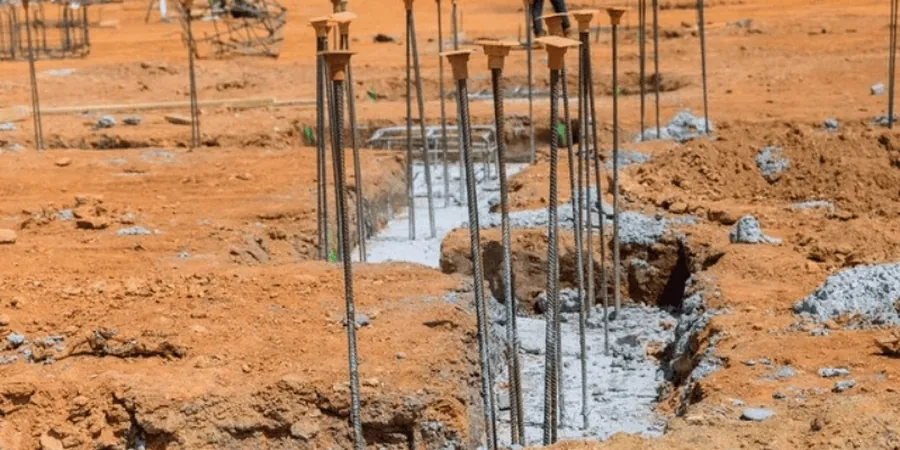
The River Boyne shaped this town. And it shaped what lies beneath it. If your Drogheda site sits on the north side near the M1 retail parks, you are probably dealing with dense glacial till. Move south of the river toward the old Marsh Road area, and the ground turns soft. Alluvial clays and silts dominate. This contrast within a single town means a one-size-fits-all foundation is a liability. Pile foundation design in Drogheda has to start with this simple fact: the bearing stratum is rarely where you expect it. We have seen competent limestone bedrock at 6 meters in one borehole and at 18 meters just 200 meters away. Before a single pile is specified, we pair the geophysical picture with direct investigation. In the northern commercial zones, where warehouse spans are long and column loads high, we often cross-check results with CPT testing to map the drift profile continuously before selecting pile type and toe level.
In Drogheda, the distance between competent rock and compressible alluvium can be less than a football pitch. Site-specific pile design is not optional—it is the only way to control settlement.
Local considerations
Contrast a site on the northern plateau near Grange Rath with a riverfront plot on the Marsh Road. Grange Rath sits on lodgement till—dense, overconsolidated, and a decent bearing material even for shallow footings. The Marsh Road area, however, is underlain by a buried channel filled with soft estuarine deposits. A pile foundation design in Drogheda that ignores this depositional history can lead to differential settlements exceeding serviceability limits. The real risk is not total collapse. It is the slow, uneven sinking that misaligns crane rails in a distribution center or cracks partition walls in a residential block. In the town center, where medieval archaeology layers complicate the stratigraphy, obstructions like old timber piles or buried masonry can deflect a bored pile during installation. Our approach includes a desk study of historical maps and geophysical pre-screening before a single rig mobilizes. When the ground profile is highly variable, we specify preliminary pile load tests early in the program to validate the design assumptions before production piling begins.
Frequently asked questions
How much does a pile foundation design cost for a typical Drogheda site?
For a design package covering site investigation specification, pile type recommendation, and axial capacity calculations, the cost generally falls between €1,410 and €6,440 depending on the number of boreholes, the complexity of the soil profile, and whether static load tests are included in the scope.
Which pile type works best in Drogheda's limestone bedrock?
Continuous flight auger piles with a short rock socket are often the most practical. The limestone here is karstified in places, so we always recommend probing ahead of the pile tip to check for voids. For very high column loads, bored piles with permanent casing through the overburden give better control over socket length and cleanliness.
How do you account for the soft alluvial soils near the River Boyne?
We run oedometer consolidation tests on undisturbed samples to quantify the settlement potential. In the pile design, we apply a negative skin friction load over the settling zone and use a bitumen coating or a permanent sleeve to decouple the pile shaft from the consolidating soil where necessary.
What deliverables do I get from the pile design package?
You receive a factual site investigation report, a geotechnical interpretive report with the ground model, and a detailed pile design report. The design report includes pile type recommendation, length and diameter options, axial capacity charts, group settlement analysis, and a specification for load testing.