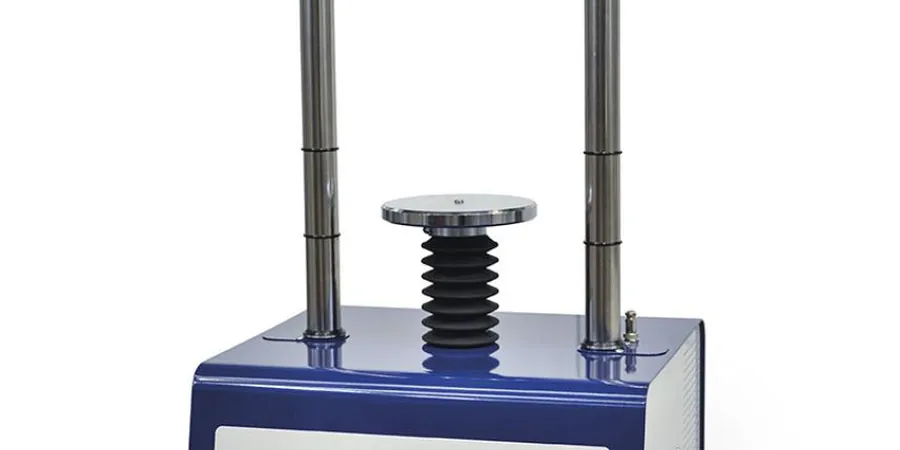
A triaxial cell sits clamped inside a load frame in the geotechnical laboratory, applying confining pressure to a cylindrical specimen while a piston drives axial compression at a controlled strain rate. The setup measures pore water pressure through a saturated porous stone, generating the effective stress paths that matter for foundation design in Drogheda. The town straddles the River Boyne, where the geology transitions from the underlying Carboniferous limestone bedrock to overlying glacial tills, fluvioglacial sands, and pockets of soft alluvial silt. Understanding how these soils behave under load requires more than index testing; consolidated-undrained (CU) and consolidated-drained (CD) triaxial tests provide the friction angle and cohesion intercept that govern bearing capacity calculations under Eurocode 7. When the Boyne floodplain deposits show high sensitivity, the laboratory runs unconsolidated-undrained (UU) tests to capture the undrained shear strength before disturbance effects fade. For deeper infrastructure near the M1 corridor, the triaxial program often complements a CPT campaign that identifies critical layers where undisturbed Shelby tube samples must be recovered for strength envelope determination.
Effective friction angles of 32 to 38 degrees are typical for Drogheda's dense glacial tills, but the alluvial silts can drop to 24 degrees undrained.
Frequently asked questions
How many undisturbed specimens are needed for a multi-stage CIU triaxial test in Drogheda?
A multi-stage CIU triaxial test can be performed on a single high-quality undisturbed specimen approximately 100 mm in diameter, provided the specimen is homogeneous. The laboratory consolidates and shears the specimen at three progressively higher confining pressures, producing three Mohr circles from one sample. For heterogeneous glacial tills with gravel lenses, we recommend three separate specimens from the same depth interval to ensure representative results.
What is the typical cost of a triaxial testing program for a site investigation in Drogheda?
A triaxial testing program in Drogheda typically ranges from €1,840 to €2,480 depending on the number of specimens, test type (UU, CIU, or CID), and whether multi-stage or single-stage protocols are used. A complete strength envelope from a single borehole depth with three CIU stages generally falls in the middle of this range, including saturation, consolidation, shearing, and the interpretive report with Mohr-Coulomb parameters.
When should a consolidated-drained (CID) triaxial test be specified instead of a CU test?
A drained triaxial test (CID) should be specified when the soil is free-draining under the expected loading rate, such as in Drogheda's fluvioglacial sands and gravelly tills, or when the designer needs the critical state friction angle for long-term drained stability analysis. The CID test measures volume change during shear, which CU tests do not provide. The strain rate for CID is set slow enough to prevent pore pressure buildup, typically 0.001 to 0.01 mm/min for sands.