HomeFoundations

Foundations in Drogheda

Together, we solve the challenges of tomorrow.

LEARN MORE →

Foundation engineering in Drogheda demands a thorough understanding of the local glacial till and alluvial deposits overlying Carboniferous limestone bedrock. The bearing capacity can vary significantly across the town, from the dense boulder clays on the northern slopes to softer, compressible silts near the River Boyne floodplain. A rigorous site investigation is essential to comply with Eurocode 7 and the Irish Building Regulations (Technical Guidance Document A). For sites with poor near-surface soils, [pile foundation design](piles) often provides the most reliable deep foundation solution, transferring structural loads to competent strata.

This category addresses the full spectrum of structural support, from residential extensions on traditional strip footings to complex commercial developments requiring ground improvement. Effective design must also integrate substructure waterproofing and gas protection, particularly in areas with made ground. For cohesive soils, assessing short and long-term settlement is critical, often necessitating advanced [slope stability analysis](slope-stability) for adjacent excavations. Ultimately, a robust foundation system ensures structural longevity by managing the specific geotechnical risks present in the Drogheda area.

Available services

Pile foundation design

→ Ver detalle

Drogheda’s layered geology, from the limestone bedrock of the Boyne Valley to the glacial tills that blanket the north side, has shaped every major civil project here since the viaduct went up in 1855. When you excavate near the river or anchor a retaining structure into the Boyne Limestone Formation, the difference between an active and a passive anchor is not academic. It determines whether your temporary works stand through winter groundwater or fail during a 1-in-50-year flood event. Our team has designed anchor systems across the town, from the steep cuts behind the Donore Road retail parks to basement retention on the south quays, where soft alluvium overlies rock at variable depth. We integrate slope stability analysis with anchor bond length calculations to ensure each tendon works within the allowable capacity of the ground.

A properly designed anchor converts ground uncertainty into a measurable, lockable force. The proof test does not lie.

Methodology and scope

The most common error we see on Drogheda sites is assuming that a passive anchor will develop full resistance in weathered till the same way it does in intact mudstone. You install the tendon, run the proof test, and the creep rate exceeds the 2 mm criterion from IS EN 1537:2013 before you hit 80 percent of design load. That is a costly remediation. Active anchors, post-tensioned to a locked-off load, give you immediate control over wall deflection, which matters when you are retaining the R132 and cannot afford more than 15 mm of lateral movement. For permanent works we specify double corrosion protection and run extended creep tests on sacrificial anchors in similar ground. Combining anchor design with deep excavations monitoring lets us adjust the stressing sequence based on real inclinometer data rather than assuming uniform soil stiffness across the site.
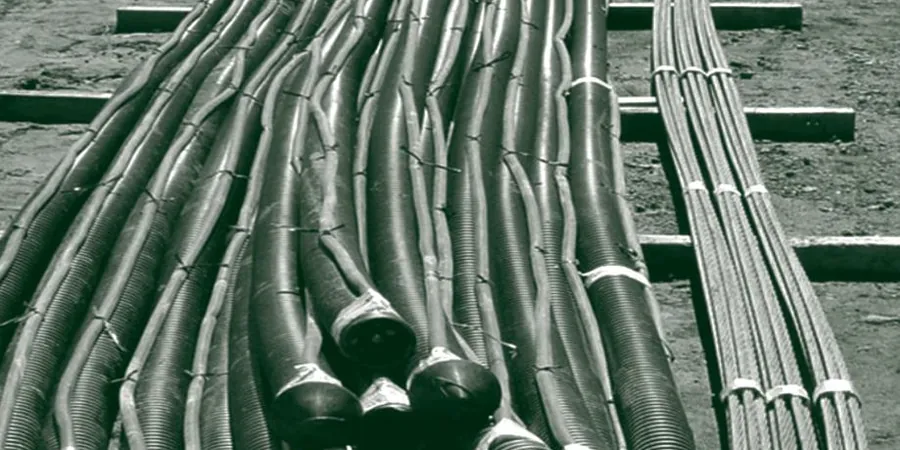
Active and Passive Anchor Design for Complex Ground in Drogheda
Technical reference image — Drogheda

Local considerations

At 53.715° N and barely 23 metres above sea level at the quays, Drogheda contends with a tidal range on the Boyne that regularly exceeds 3.5 metres. Anchor heads installed below the mean high water mark face a corrosion environment that is more aggressive than most inland sites in Ireland. We have pulled corroded bar anchors from quay walls after less than 15 years where the encapsulation was poorly detailed. The other risk is karstic voids in the Boyne Limestone. You can drill through a metre of competent rock and hit a mud-filled cavity that offers zero bond. We address this with rotary percussive drilling with air flush and record the penetration rate every 10 cm. When the ground opens up, we extend the fixed length past the void or switch to a grouting program to fill the cavity before anchor installation.

Need a geotechnical assessment?

Reply within 24h.

Email: contact@geotechnical-engineering.co

Technical parameters

ParameterTypical value
Design standardIS EN 1997-1:2005 (Eurocode 7)
Execution standardIS EN 1537:2013 (Ground anchors)
Bond length in limestone4.0–8.5 m (depending on roughness)
Bond length in glacial till6.0–14.0 m (post-grouting required)
Typical working load (active)250–1,200 kN per strand anchor
Lock-off load110% of service load (temporary), 100% (permanent)
Corrosion protection classClass I (permanent, double barrier)

Associated technical services

01

Temporary active anchor systems for deep excavations

For basement and cut-and-cover works within the town centre, we design multi-level active anchors with staged stressing sequences. Each anchor is proof-tested to 1.25 times the service load in accordance with IS EN 1537, with load cells on selected tendons to verify the lock-off force does not relax before the permanent slabs are cast.

02

Permanent passive anchors for retaining structures

Where long-term stability governs, such as the retaining walls along the R132 approach roads, we specify passive anchors grouted into the limestone. We determine the ultimate bond stress from site-specific pull-out tests, not from published correlations, and apply a partial factor on resistance of 1.35 for the persistent design situation.

03

Anchor corrosion protection upgrade and remediation

For existing quay walls and bridge abutments in Drogheda, we assess residual anchor capacity through lift-off tests and design remedial anchors where corrosion has reduced the steel cross-section. The new anchors are installed with Class I double-corrosion protection and connected to a revised load distribution beam.

Applicable standards

IS EN 1997-1:2005 (Eurocode 7: Geotechnical design), IS EN 1537:2013 (Execution of special geotechnical work: Ground anchors), IS EN 1990:2002 (Basis of structural design), BS 8081:2015 (Code of practice for grouted anchors), CIRIA C760 (Guidance on embedded retaining wall design)

Frequently asked questions

What is the price range for anchor design on a Drogheda project?

Anchor design fees typically range from €850 for a single anchor verification with pull-out test interpretation to €3,210 for a multi-level anchored wall package covering design, proof-test specification, and construction-phase review. The final scope depends on the number of anchor levels, whether temporary or permanent protection is required, and the complexity of the ground profile across the site.

How do you verify the bond length for anchors in Drogheda's glacial till?

We run on-site suitability tests on sacrificial anchors before production drilling begins. The test anchor is loaded incrementally to 1.5 times the design load while measuring creep at each step. If the creep rate exceeds 2 mm per log cycle of time between 15 and 50 minutes, we extend the fixed length or specify post-grouting with a water-cement ratio of 0.45 to improve the soil-grout interface. The final bond length is confirmed only when the test data satisfies the acceptance criteria of IS EN 1537.

Can you design anchors within 5 metres of protected structures in Drogheda?

Yes, we have designed anchors adjacent to listed buildings on West Street and near the viaduct. We use smaller-diameter duplex drilling with sympathetic vibration monitoring, install the anchors at a flatter inclination to stay below foundation level, and often specify removable strand anchors so no steel is left in the ground beyond the temporary works period. A condition survey of the adjacent structure is mandatory before drilling begins.
Location and service area

We serve projects across Drogheda and its metropolitan area.

View larger map