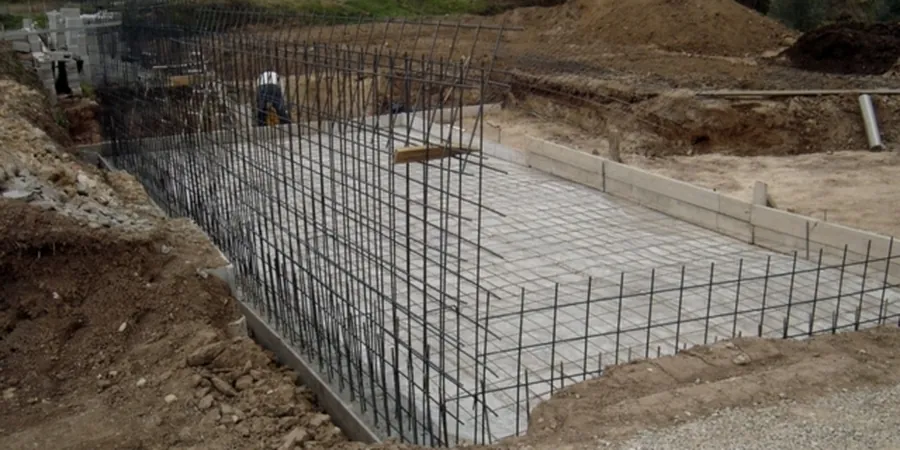
Shallow foundation design in Drogheda must account for the complex transition between the underlying glacial till and the softer alluvial deposits along the River Boyne. Eurocode 7 (EN 1997-1:2004) requires that the ultimate limit state for bearing resistance be verified against a ground model that captures these lateral and vertical variations, which in Drogheda can shift within a single site. Our approach integrates laboratory triaxial testing of undisturbed Shelby tube samples with in-situ SPT drilling to calibrate strength parameters, ensuring that the design bearing pressure does not exceed the drained shear strength of the lodgement till. We also run consolidation tests on the occasional lacustrine clay lenses found beneath the town center, because differential settlement has historically affected structures north of West Street. The groundwater table here tends to be shallow, often within 2 m of the surface, so we assess buoyancy effects and potential softening of the bearing stratum under long-term saturation. A site on the north bank of the Boyne required a rigorous slope stability check where the foundation level was within the zone of influence of the riverbank, and we coupled the shallow footing design with a global stability analysis to satisfy the GEO limit state.
In Drogheda, the allowable bearing pressure on glacial till can exceed 200 kPa, but a single lens of soft alluvium at depth can double the calculated settlement.
Methodology and scope
Drogheda’s population of approximately 44,000 occupies a landscape shaped by the Boyne Valley, where the superficial geology includes glaciofluvial sands and gravels that can exhibit relative densities below 40% in certain pockets near the M1 corridor. Designing a shallow foundation here means confronting the risk of excessive immediate settlement in loose granular layers, which we quantify through elastic settlement methods using a constrained modulus derived from
CPT testing. The town’s historic core, with its medieval plot boundaries, often presents made ground up to 3 m thick, containing brick fragments and organic silt; this material is unsuitable for bearing and demands either removal and replacement with engineered fill or deepening the foundation to the competent till. We apply the bearing capacity formulation from Annex D of EN 1997-1, adjusting the shape and inclination factors for eccentrically loaded strip footings common in urban infill projects. For structures near the railway viaduct, we also consider cyclic loading effects and the potential for densification of the subgrade, and we sometimes recommend a limited
stone column treatment to homogenize the stiffness profile beneath the footing. Our laboratory in Drogheda runs Atterberg limits and particle size distribution on each stratum to classify the soil according to IS EN ISO 14688, which feeds directly into the selection of bearing resistance factors.
Local considerations
The ground investigation for shallow foundations in Drogheda typically begins with a tracked rotary rig deploying hollow-stem augers to penetrate the stiff upper crust of the till. When the auger encounters the cobble-rich matrix that characterizes the Boyne glacial sequence, we switch to a rotary core barrel to retrieve a continuous sample, because refusal on a boulder can be misinterpreted as bedrock if the driller is unfamiliar with local conditions. The primary geotechnical hazard is the undetected presence of a soft clay or peat lens beneath the proposed footing, which can lead to excessive long-term settlement and serviceability failures in masonry walls. A secondary concern is the seasonal fluctuation of the water table within the alluvial gravels, which alters effective stress and can trigger collapse settlement in partially saturated silts. We mitigate these risks by specifying a minimum number of investigation points per IS EN 1997-2, with at least one boring extended to twice the footing width below the base level, and by installing standpipe piezometers to monitor the groundwater regime for a full hydrological cycle before finalizing the design.
Frequently asked questions
What is the typical depth for a shallow foundation in Drogheda’s till?
The minimum embedment depth is usually 1.0 m to avoid frost action and seasonal moisture variation. On sloping sites or where the till surface is irregular, we increase the depth to 1.2–1.5 m to ensure the entire footing bears on undisturbed, competent material.
How do you verify that the designed bearing pressure is safe on Drogheda soils?
We cross-check the analytical bearing capacity from Eurocode 7 Annex D against the results of in-situ tests (SPT N-values or CPT cone resistance) and laboratory triaxial tests. For settlement-sensitive structures, we run a 1-D consolidation analysis using oedometer moduli measured on undisturbed samples from the critical depth.
What is the approximate cost of a shallow foundation design package for a house extension in Drogheda?
For a typical single-storey extension, the design package – including a limited ground investigation, laboratory classification, bearing capacity calculation, and a signed design certificate – ranges from €1.490 to €2.530, depending on access constraints and the number of trial pits or boreholes required.
Do I need a separate ground investigation for a raft foundation on Drogheda’s alluvial soils?
The reference range for this service in Drogheda is €1.490 - €2.530. The final price depends on the project scope and volume.