← Home · Investigation

SPT Testing in Drogheda – Standard Penetration Test for Site Investigation

Together, we solve the challenges of tomorrow.

LEARN MORE →

The layered glacial tills and river gravels beneath Drogheda don’t give straight answers without real subsurface data. A desk study won’t tell you where the soft silts pocket or how dense the boulder clay actually is at ten metres. That’s why developers along the Boyne corridor rely on the Standard Penetration Test to get N-values they can take to their structural engineer. In a town where medieval cellars sit beside new apartment blocks, knowing what’s underneath before you excavate saves money and avoids surprises. Our SPT crews work from the Donore Road industrial estates to the quayside redevelopments, bringing the rig to you and providing a factual report within the week. For deeper profiling in variable ground, we often pair SPT with CPT testing where continuous readings are needed through interbedded sands and clays.

An SPT N-value isn’t just a number – it’s the difference between overdesigning your foundations and getting it exactly right for the ground you actually have.

Methodology and scope

Eurocode 7 (EN 1997-2:2007) governs ground investigation in Ireland, and the standard penetration test remains the most widely specified in-situ method for determining the density and consistency of Drogheda’s drift deposits. Our equipment complies with BS EN ISO 22476-3:2005, using an automatic trip hammer that delivers consistent energy – critical when comparing results across multiple boreholes on the same site. The test drives a split spoon sampler 450 mm into the soil, recording blow counts for each 150 mm increment. That N-value feeds directly into bearing capacity calculations, liquefaction assessments, and settlement predictions. In Drogheda’s mixed geology, where you can hit gravel lenses within metres of soft lacustrine clay, we recommend complementing SPT data with grain size analysis to confirm soil classification and drainage characteristics before finalising the foundation design.
SPT Testing in Drogheda – Standard Penetration Test for Site Investigation
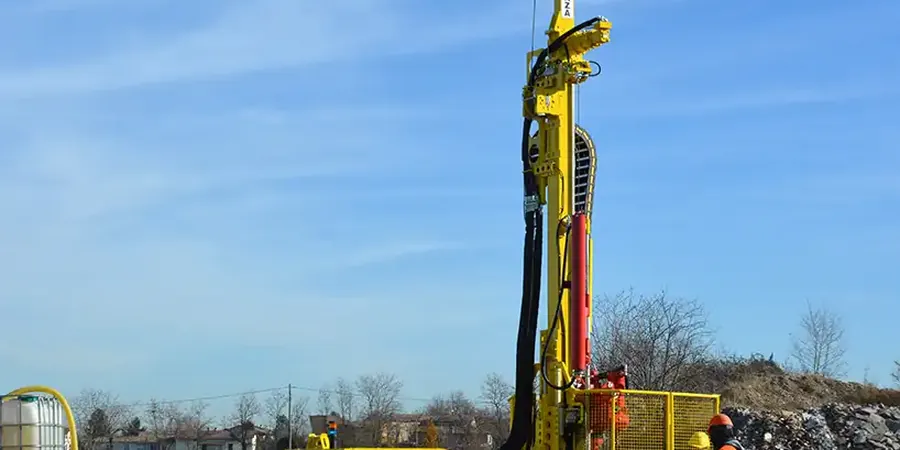
Technical reference image — Drogheda

Local considerations

Drogheda sits on a complex Quaternary sequence: glacial till overlying Carboniferous limestone, with pockets of alluvial sand and gravel along the Boyne floodplain. The till itself varies enormously – stiff boulder clay in some areas, loose ablation till in others. What catches out inexperienced contractors is the perched groundwater within the gravel lenses. You hit dry clay at two metres, then water pours in at four when you break into a sand seam. That sudden change destabilises open boreholes and can wash fines into your excavation. A properly executed SPT program logs these transitions before they become site problems. The N-values also flag zones where driven piles will refuse early or where vibrocompaction might be needed to densify loose granular layers. In a town expanding rapidly onto brownfield and greenfield sites, skipping the subsurface investigation is a risk no lender or insurer will accept.

Need a geotechnical assessment?

Reply within 24h.

Email: contact@geotechnical-engineering.co

Explanatory video

Technical parameters

ParameterTypical value
Standard followedBS EN ISO 22476-3:2005
Hammer typeAutomatic trip hammer (safety hammer)
SamplerStandard split spoon (51 mm OD)
Drive length450 mm (3 x 150 mm increments)
Borehole diameter76–150 mm, depending on depth and casing
Typical test depths in Drogheda5–25 m bgl, extended in deep till sequences
ReportingN-value per increment, SPT N60 energy-corrected, soil description log

Associated technical services

01

SPT Borehole Drilling & Sampling

Cable percussion and rotary drilling across Drogheda, with SPTs at standard 1.5 m intervals or as specified by the project engineer. Disturbed and undisturbed samples recovered for lab testing.

02

N60 Energy-Corrected Reporting

Raw blow counts corrected for hammer energy, rod length, and overburden pressure. This gives your designer the design N-value they need for bearing capacity and settlement calculations under Eurocode 7.

03

Combined SPT-CPT Investigations

On sites with complex stratigraphy we run cone penetration testing alongside SPT boreholes. The CPT fills in the gaps between boreholes and identifies thin layers the split spoon might miss.

04

Laboratory Testing Suite

All samples go to our ISO 17025 accredited lab for classification, shear strength, and compressibility testing. Turnaround is fast because we know contractors in Drogheda don’t wait weeks for results.

Applicable standards

BS EN ISO 22476-3:2005 – Geotechnical investigation and testing. Field testing. Standard penetration test, Eurocode 7 (EN 1997-2:2007) – Ground investigation and testing, IS EN 1998-1:2005 – Design of structures for earthquake resistance (National Annex for Ireland)

Frequently asked questions

How much does an SPT test cost in Drogheda?

A typical SPT borehole in the Drogheda area runs between €480 and €580 per point, depending on access conditions, depth, and whether casing is needed through loose ground. A full site investigation with multiple boreholes, lab testing, and a factual report will be quoted based on the scope – call us with your site address and we’ll have a number to you within 24 hours.

How deep do you need to drill for an SPT in Drogheda?

It depends on the foundation type and the ground. For a typical two-storey house on strip footings, 6–10 metres is usually enough to prove the bearing stratum. Larger commercial projects in the town centre or on the floodplain often require 15–25 metres, especially where piles are being considered and you need to confirm refusal depth in the limestone bedrock.

How long does it take to get SPT results back?

The borehole log with field N-values is available the same day or next morning. If you need lab testing on the samples – Atterberg limits, triaxial, or consolidation – allow 5 to 7 working days. We can prioritise urgent jobs for projects where the piling rig is already booked.

What’s the difference between SPT N-value and N60?

The raw N-value is what the driller records at the rig. The N60 corrects that number for the actual hammer energy delivered, because not every hammer hits with exactly 60% of theoretical free-fall energy. Eurocode 7 design methods require N60, so we report both and explain the conversion in plain English for your structural engineer.
Location and service area

We serve projects across Drogheda and its metropolitan area.

View larger map