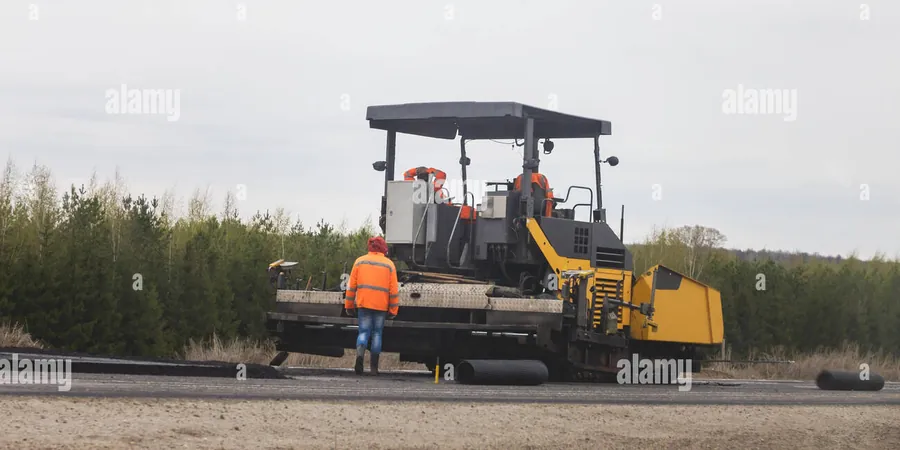
A common mistake in Drogheda is treating the whole town as if it sits on uniform ground. The reality is far more complex. Pushing through a standard pavement section without accounting for the soft alluvial clays along the Boyne or the stiffer glacial tills on the northern approaches leads to premature rutting and edge cracking within the first two years. Over a dozen local industrial estate expansions we have reviewed started with a generic 300 mm granular layer that failed simply because the subgrade CBR was half of what the designer assumed. In Drogheda, getting the pavement design right means reconciling the NRA Road Drainage Manual with the actual seasonal moisture condition of the subgrade, something that cannot be read from a desk. A thorough site investigation pinpoints the weak spots, and combining that data with a CBR assessment ensures the pavement cross-section matches real ground behaviour rather than optimistic defaults.
In Drogheda, the difference between a 15-year and a 25-year pavement often comes down to one soaked CBR test on the subgrade in February.
Methodology and scope
Drogheda’s population has pushed past 44,000, driving steady demand for residential distributor roads, retail park parking areas, and upgraded access routes in the expanding south side. What many developers overlook is that the town straddles a geological boundary: calcareous shale and greywacke bedrock outcrop on the north bank, while the south bank is dominated by post-glacial river deposits with silt and peat lenses. A pavement design in Drogheda therefore has to handle abrupt transitions within the same scheme. We typically couple the
in-situ permeability assessment with falling-head tests in trial pits to establish whether the granular capping layer will drain freely or trap water beneath the bound layers. For heavily trafficked bus nodes near the railway station, we often specify a
CBR test protocol that includes soaked conditions to replicate what happens after a wet winter when the water table rises within the Boyne floodplain. The design life target of 20 to 40 years, depending on traffic class, forces us to balance initial construction cost against whole-life maintenance — and in Drogheda that nearly always means investing in a stronger sub-base rather than over-thickening the asphalt.
Local considerations
One thing we consistently observe in Drogheda is that the original site investigation boreholes stop at 3 metres, missing the deeper peat pockets that are common in the Mell and Marsh Road areas. A pavement built over an undetected peat lens will settle differentially, creating a washboard surface within three winters. The remedy is never cheap: partial reconstruction plus a geogrid-reinforced capping layer. Another local risk is poor drainage detailing around gullies at low points on the Donore Road industrial spine; standing water softens the formation, and once the bound layers crack, water pumps fines out of the sub-base, accelerating structural failure. For large distribution centres with heavy forklift loading, we also check whether dynamic wheel loads could trigger excess pore pressure in saturated silt — a mechanism that standard empirical design curves do not capture.
Frequently asked questions
What is the typical cost of a flexible pavement design package for a Drogheda car park?
For a standard car park or access road in Drogheda, the design package — including site investigation, laboratory CBR testing, and pavement cross-section calculations — generally falls between €1,430 and €5,060, depending on the number of trial pits, the traffic class, and whether an FWD survey is required for an existing pavement.
How do Drogheda’s soil conditions affect pavement design?
Drogheda sits on a mix of glacial till, alluvial clay, and occasional peat pockets, especially south of the Boyne. The subgrade can change from stiff boulder clay to soft silt within 50 metres. This forces us to run soaked CBR tests at close intervals and design the capping layer to handle poor-draining soils, otherwise the pavement will rut and crack prematurely.
Do you use the NRA DMRB or the UK DMRB for Drogheda projects?
We follow the NRA DMRB Volume 7, which is the Irish national standard adapted from the UK DMRB. All our designs reference TII specifications for materials and workmanship, ensuring the pavement is compliant with local authority adoption requirements in County Louth and Meath.
Can you design a flexible pavement for a residential estate road in Drogheda?
Yes, residential estate roads are a common request. We design to TII Class 1 or Class 2 foundation conditions, typically with a 40 mm surface course, 60 mm binder, and 200–250 mm of Clause 804 sub-base over a capping layer. The exact section depends on the soaked CBR and the number of heavy goods vehicles expected during the housing construction phase.