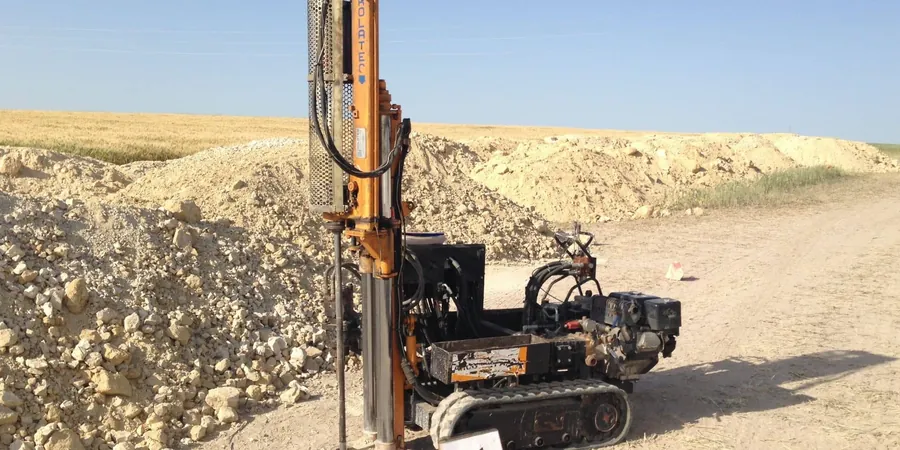
The ground conditions in Drogheda can vary significantly between the north and south banks of the River Boyne. On the northern side, near the historic Millmount complex, you often encounter dense glacial tills that can hold perched water, while the southern approaches toward the expanding residential estates on the Rathmullen Road tend to sit on limestone-derived marls where fissure flow becomes the dominant concern. We’ve seen projects where assuming a single bulk permeability value across the site led to completely inaccurate dewatering plans. That’s precisely why we run in-situ field permeability tests—both Lefranc and Lugeon—to capture the real hydraulic conductivity of each stratum, rather than relying on lab values that can miss the influence of cracks, lenses, and variable weathering typical of the Drogheda subsurface. A CPT test can also help delineate the vertical sequence of these layers before committing to a permeability testing program.
In the glacial till overlying the Drogheda limestone, a Lefranc test can yield permeability values two orders of magnitude lower than a Lugeon test in the fractured rock just two meters below.
Local considerations
One thing we keep noticing in the Drogheda area is that contractors sometimes treat the weathered limestone interface as an aquiclude, when in reality it’s often a high-permeability conduit. The contact between the overlying till and the karstified upper bedrock can transmit significant volumes of water, especially after heavy rain when the River Boyne is in flood stage. If you skip the in-situ packer testing and just extrapolate from a few lab perm tests on intact core, you’re going to underestimate the inflow during excavation. We’ve seen temporary slopes destabilize precisely because this interface wasn’t properly characterized. A proper Lugeon program in Drogheda’s bedrock, combined with Lefranc testing in the overburden, gives the dewatering designer the numbers they actually need—not just textbook assumptions.
Frequently asked questions
What is the difference between the Lefranc and Lugeon tests?
The Lefranc test measures hydraulic conductivity in soil or soft, weathered rock by injecting or removing water from an open borehole section. The Lugeon test is specifically for rock, where a packer isolates a section of the borehole and water is injected under pressure. The Lugeon gives a measure of fracture connectivity, while the Lefranc is more representative of porous media flow. In Drogheda, we often use both in the same borehole—Lefranc in the overburden and Lugeon once competent limestone is reached.
How much does a field permeability test cost in Drogheda?
A complete permeability testing package in the Drogheda area, including mobilisation and execution of either Lefranc or Lugeon tests depending on the ground, generally ranges from €620 to €830 per test interval. The final cost depends on borehole depth, number of test stages, and access conditions on site.
When is a Lugeon test required instead of a Lefranc test?
A Lugeon test is required when the investigation encounters rock that is competent enough to allow a packer seal, typically in the limestone formations underlying Drogheda. If the rock is too fractured or the borehole walls collapse, a Lefranc test may still be feasible. The decision is made on site by the supervising engineer based on the core recovery and rock quality designation observed during drilling.
How many Lugeon pressure stages should be run?
We standardly run a five-stage Lugeon test consisting of low, medium, high, medium, and low pressure steps. This cycle helps identify whether the rock mass displays laminar flow, turbulent flow, dilation, or clogging behaviour. The pressure sequence is designed according to the ISRM suggested method, and the results are plotted as a Lugeon-pressure curve for interpretation.