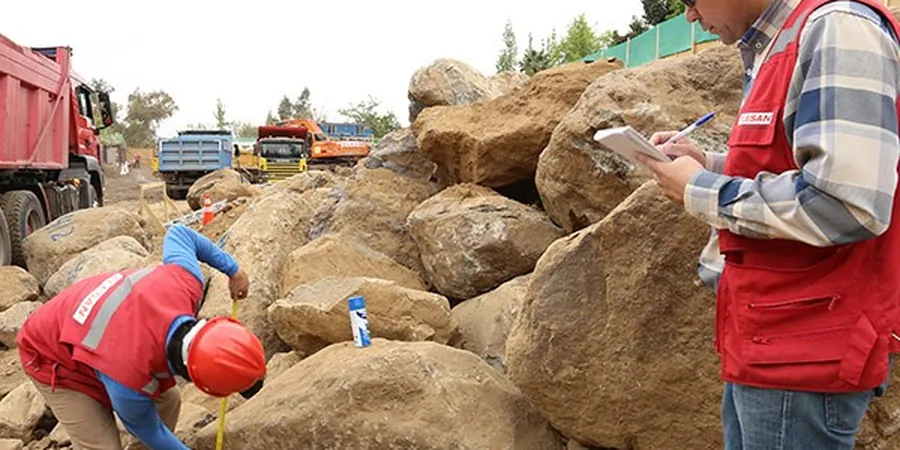
One of the most expensive mistakes a developer can make in Drogheda is treating the entire site as uniform ground. The River Boyne has carved a valley of highly variable deposition, where a dense glacial till can transition into soft alluvial silts within the span of a single building footprint. We have seen projects where a standard presumptive bearing pressure was used without a proper soil mechanics study, leading to differential settlement that cracked structural walls before the roof was even on. Our team enters every site assuming heterogeneity, particularly where the underlying geology shifts from the late Pleistocene till to the underlying Carboniferous shales and limestones that define the Boyne Valley. For deep foundation design, we often pair this investigation with piles analysis to quantify shaft friction in the lodgement till, a parameter that varies dramatically with the clay fraction and consolidation history of the deposit.
In Drogheda, the difference between a €2,500 soil mechanics study and a €250,000 foundation failure often comes down to one missed silt lens in the borehole log.
Methodology and scope
The soil conditions on the southern bank near the Millmount Martello Tower bear almost no resemblance to what you find on the northern floodplain approaching the M1 retail parks. South of the river, the ground is dominated by a stiff, reddish-brown lodgement till with a high stone content and significant over-consolidation from the last glacial maximum, often allowing for spread footings at relatively shallow depths when properly analyzed. Cross the river toward the Donore Road industrial estates, however, and the soil mechanics study must contend with interbedded lenses of soft clay and saturated fine sand that can liquefy under cyclic loading. In these low-lying areas, we incorporate
liquefaction assessment directly into the soil mechanics study to evaluate the cyclic stress ratio and the potential for strength loss during a seismic event. The contrast between these two zones, separated by barely a kilometer, is why we never extrapolate borehole data across the town without a thorough stratigraphic correlation.
A solid soil mechanics study for Drogheda must capture the triaxial shear strength parameters of the till while also identifying the compressibility of any interglacial silts. Our laboratory program typically includes consolidated-undrained triaxial tests with pore pressure measurement, consolidated isotropic or anisotropic scenarios depending on the expected field stress paths, and one-dimensional consolidation tests to generate the constrained modulus for settlement predictions. When the project involves excavation support near existing Georgian or Victorian structures along West Street, the study must also define the lateral earth pressure coefficients and the undrained shear strength profile that will govern the performance of temporary shoring systems.
Local considerations
Eurocode 7 (IS EN 1997-1:2004 + IS EN 1997-2:2007 with Irish National Annex) mandates that ground investigations account for the specific geological and hydrogeological complexity of the site. In Drogheda, this means the soil mechanics study cannot simply confirm a bearing capacity value; it must explicitly address the risk of buried soft layers beneath a stiff crust, a condition we have documented repeatedly in boreholes along the Marsh Road and the periphery of the old port area. The town's position on the Drogheda Syncline introduces additional uncertainty, as the rockhead can plunge rapidly beneath channels filled with compressible estuarine deposits. If a geotechnical report does not delineate these buried channels, the resulting differential settlement can shear utility connections and render floor slabs unserviceable. We treat every soil mechanics study as a forensic exercise in defining the spatial boundaries between competent and problematic ground, because the consequence of mischaracterization is not theoretical here; it is measured in structural distress and costly remedial underpinning.
Applicable standards
IS EN 1997-1:2004 + Irish National Annex (Eurocode 7), IS EN 1997-2:2007 (Ground Investigation and Testing), IS EN ISO 17892-12:2018 (Atterberg limits), IS EN ISO 17892-9:2018 (Triaxial compression), IS EN ISO 22475-1:2006 (Sampling and groundwater), NCEER/Youd-Idriss (2001) for liquefaction triggering
Frequently asked questions
What does a soil mechanics study in Drogheda typically cost?
For a standard residential or light commercial project in the Drogheda area, a comprehensive soil mechanics study generally ranges from €2.510 to €5.450, depending on the number of boreholes required, the depth to bedrock, and the laboratory testing program specified by Eurocode 7. A site with complex geology near the Boyne floodplain or requiring triaxial testing will trend toward the upper end of that range.
How deep do you investigate the ground in Drogheda?
The depth of investigation depends on the foundation type and the geological horizon. For shallow foundations, we typically extend the soil mechanics study to a depth of 1.5 to 2 times the footing width below the bearing stratum, or until we confirm competent till or bedrock. For piled foundations, we core into the Carboniferous limestone a minimum of 3 meters to prove competent rock and rule out karstic voids, which are a known feature in the Dublin Basin limestones that extend north toward Drogheda.
How long does it take to complete the soil mechanics study and deliver the report?
From the start of fieldwork to the delivery of the interpretive geotechnical report, a typical Drogheda soil mechanics study takes between three and four weeks. The field investigation and sampling are usually completed in two to three days, but the consolidation and triaxial tests require curing and shearing time that cannot be accelerated without compromising the quality of the pore pressure data.
Do you test for pyrite in the glacial till around Drogheda?
We include pyrite assessment as part of the soil mechanics study when the site is underlain by the shale-rich lodgement till, following the methodology in IS 398-1:2017. We test total sulfur content and, if elevated, proceed to acid-base accounting to quantify the swelling potential. This is a critical step for any project using engineered fill or hardcore beneath floor slabs in the northeast of Ireland.
Can your soil mechanics study support a planning application in Louth County Council?
Yes. Our reports are structured to satisfy the geotechnical submission requirements of Louth County Council and the Building Control (Amendment) Regulations. The soil mechanics study includes the site investigation methodology, factual borehole logs, laboratory test certificates, and a detailed interpretive section that addresses bearing capacity, settlement, groundwater, and any geohazards such as flooding or slope instability relevant to the Drogheda site.