Drogheda’s story is written in its river. The Boyne has shaped this town for over 800 years, carving the valley and depositing the thick alluvial silts that now underpin much of the south bank and the expanding residential zones near the M1. When the town began its modern growth spurt—think Scotch Hall, the Donore Road retail parks, the new housing clusters off the Rathmullan Road—foundation design stopped being a simple matter. Those soft, water-saturated sediments demand more than a standard bearing capacity check. In our experience along the east coast, the question is not whether the ground is weak, but how it behaves when shaking starts. A seismic microzonation study can map the hazard at a district scale, and for the sites we test in Drogheda, a CPT profiling campaign provides the continuous stratigraphy needed to feed a reliable liquefaction model.
Liquefaction in Drogheda is not a distant seismic scenario—it is a local stratigraphic reality governed by the Boyne’s soft alluvial silts and a shallow water table.
Local considerations
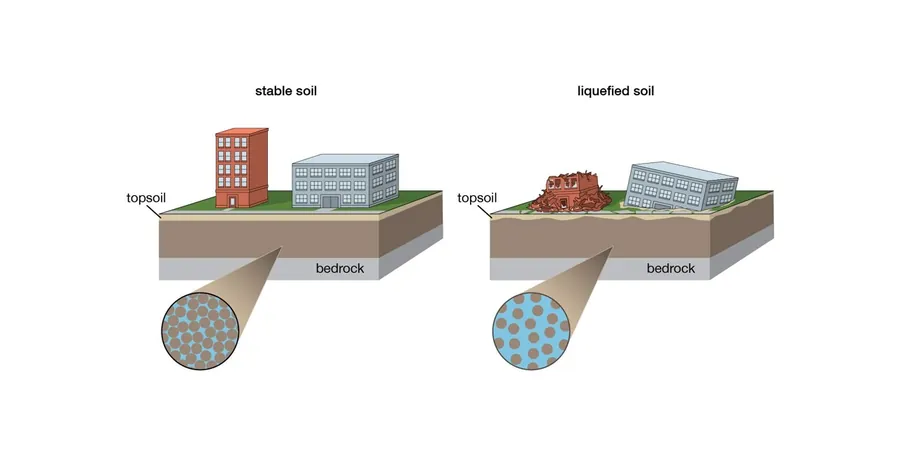
The British Geological Survey’s mapping of the Irish east coast confirms that Drogheda sits on a patchwork of Late Pleistocene till and Holocene alluvium. The alluvial band hugging the south bank of the Boyne is the problem. It consists of loose, normally consolidated silty sand with intermittent peat lenses—a classic liquefiable profile. When the 2013 Irish National Annex to Eurocode 8 placed this region in a low-to-moderate seismicity category, some designers assumed liquefaction was irrelevant. The alluvium says otherwise. Even at a modest PGA of 0.10g, the fine sand layers can lose effective stress and mobilise into a fluid-like state. For structures with a fundamental period above 0.5 seconds, the resulting settlement—often 30 to 80 mm according to the LPI method—can crack slabs, tilt shallow footings, and sever buried utilities. The risk is magnified on brownfield plots where historical fill masks the natural stratigraphy, making a desk-study alone dangerously incomplete without borehole verification.
Frequently asked questions
Is liquefaction a genuine concern in Drogheda given Ireland’s low seismicity?
Yes, it is a material concern for specific soil profiles. While Ireland experiences infrequent moderate earthquakes, Eurocode 8 and the Irish National Annex still require a liquefaction check when the ground profile contains saturated, loose sand or silt layers within 20 m of the surface, and the design PGA exceeds 0.05g. Drogheda’s south bank alluvium—with SPT N-values often below 10 and a water table near 1 m depth—falls squarely into that category. The analysis is not about predicting a large earthquake; it is about recognising that even a small event could trigger disproportionate damage in susceptible ground.
What ground investigation data is required before running the liquefaction analysis?
You need at least one properly logged borehole with SPT N-values recorded every 1.5 m or at stratum changes, down to a minimum of 20 m or refusal. The groundwater level must be measured on the day of drilling after allowing for stabilisation. We also require sufficient disturbed samples for grain-size distribution and Atterberg limits tests in the laboratory, because the fines content and plasticity directly affect the cyclic resistance. When the stratigraphy is complex—thin sands interbedded with silt—a CPT profile alongside the borehole dramatically improves the layer identification and the reliability of the settlement estimate.
How much does a liquefaction analysis cost for a typical Drogheda project?
For a single residential plot or a small commercial site, the liquefaction analysis component—including SPT drilling, laboratory classification, and the engineering report with FS profiles and settlement estimates—typically falls in the range of €1,970 to €3,570. The final figure depends on the number of boreholes, the depth required to reach competent strata, and whether a CPT campaign is added to refine the settlement calculations. Larger multi-building developments with phased investigations will exceed the upper end of that range due to the increased testing volume.
What happens if the analysis confirms a high liquefaction potential?
The report will quantify the risk through a factor of safety profile and an estimated ground settlement for the design earthquake. If the factor of safety drops below 1.0 for any layer, we recommend ground improvement measures—vibrocompaction or stone columns are the most common in Drogheda’s sandy alluvium—or a foundation solution that bypasses the liquefiable zone, such as piles socketed into the underlying glacial till. The settlement estimate also allows the structural engineer to design for tolerable differential movements, which is sometimes the most economical path for light structures on stiffened rafts.