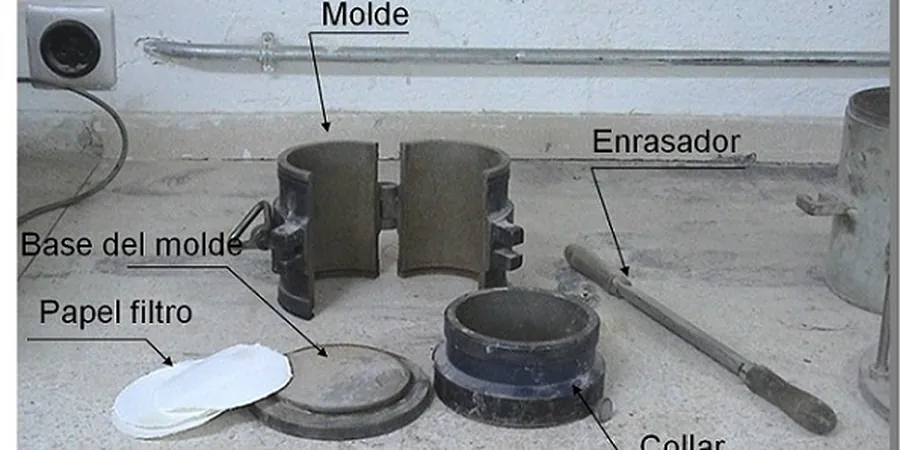
The automatic Proctor hammer drops 4.5 kg from 457 mm in the heavy compaction moulds running at our lab just outside the Boyne Valley industrial estate. In Drogheda, where glacial tills and laminated clays dominate the subgrade, getting the moisture–density relationship right before placing structural fill saves weeks of rework. We run both Standard and Modified Proctor on material sampled from boreholes or test pits opened across sites from Bryanstown to the Donore Road extension. The five-point compaction curve we deliver to the contractor’s earthworks supervisor defines a single target density that the sand cone density crew then tracks during placement. Each test runs under BS 1377-4:1990, with the compaction effort matched to the design specification: typically 2.5 kg rammer × 300 mm drop for standard effort, and the 4.5 kg × 457 mm combination for modified effort on heavily trafficked pavement subgrades.
The Proctor curve defines the single moisture content at which a given compactive effort yields maximum density — miss it by 2% water and you lose 5% density.
Methodology and scope
The laminated boulder clays north of the Boyne River in Drogheda often carry silt seams that make moisture control critical during compaction. Our lab team processes the material through a 20 mm or 37.5 mm sieve depending on the maximum particle size, then runs the full five-point Proctor curve — adding water incrementally from dry-of-optimum through wet-of-optimum — to pinpoint the peak of the parabolic density relationship. The derived values feed directly into the earthworks specification: maximum dry density (MDD) and optimum moisture content (OMC). For granular fills used as capping layer beneath industrial slabs on the Donore Road, we typically run the vibrating hammer method under BS 1377-4 to avoid particle crushing that skews the standard rammer result. The lab reports include the full compaction curve chart, air voids line at 0, 5, and 10%, and the achieved degree of saturation, giving the site engineer immediate acceptance criteria for the nuclear gauge or sand replacement density tests that follow during construction.
Frequently asked questions
What is the difference between Standard and Modified Proctor?
Standard Proctor uses a 2.5 kg rammer dropping 300 mm into a 1-litre mould, delivering 595 kJ/m³ of compactive energy. Modified Proctor uses a 4.5 kg rammer dropping 457 mm, delivering 2,680 kJ/m³ — roughly 4.5 times the energy. Modified typically yields 5–10% higher maximum dry density and a lower optimum moisture content, matching the heavier compaction plant used on road subgrades and heavily loaded industrial slabs. In Drogheda, the standard effort is specified for landscape fill and general embankments, while the modified effort is reserved for pavement capping and crane hardstandings.
How much does a Proctor test cost in Drogheda?
A single Proctor curve (Standard or Modified) ranges from €100 to €210 depending on whether we run the 1-litre or CBR mould method and whether particle density determination is included. A combined Standard + Modified package on the same material typically falls at the upper end of that range. The vibrating hammer method for granular fills is quoted separately due to the additional preparation steps required.
How long does the Proctor test take?
The laboratory compaction procedure itself runs over one working day, including the staged moisture additions and density measurements. However, clay-rich glacial tills from Drogheda sites often require overnight air-drying or low-temperature oven drying before the test can start, so the full turnaround from sample receipt to certified report is typically 3 to 5 working days. We can expedite to 2 days for urgent earthworks hold points when arranged in advance.
Can you test material with oversized particles?
BS 1377-4 allows particles up to 37.5 mm in the CBR mould, but material retained on that sieve must be replaced with an equal mass of material passing 37.5 mm and retained on 20 mm — the replacement method — or the test is run on the finer fraction with a correction applied. For coarse granular fills with significant cobble content, we recommend the vibrating hammer method, which accommodates larger moulds and reduces particle crushing. Our lab will advise on the appropriate method once we see the grading curve.
What moisture condition should the sample be in when delivered to the lab?
Ideally the sample should be sealed in a plastic bag immediately after excavation to preserve the natural moisture content. We prefer at least 25 kg of material — roughly a full rubble sack — to allow for the five-point curve plus moisture content determinations. If the sample arrives saturated from rain, we will air-dry it in the lab before starting the compaction series; drying from the wet side produces a less reliable curve than building it up from the dry side, so we always aim to start 2–3% below the estimated optimum.