← Home · Geophysics

MASW & VS30 Testing in Drogheda – Shear Wave Velocity Profiles

Together, we solve the challenges of tomorrow.

LEARN MORE →

Drogheda sits on the banks of the Boyne, and the geology here shifts quickly. You get limestone bedrock near the surface in some parts, and deep alluvial deposits closer to the estuary. That contrast matters when you are designing for earthquake loads. A MASW survey gives you the shear wave velocity profile without drilling through everything. We run the array, process the dispersion curve, and deliver a VS30 classification that ties directly into Eurocode 8 site categories. For sites where the near-surface is highly variable, combining MASW with a few test pits helps confirm the layering and avoids misinterpreting a stiff clay lens as bedrock.

A 15% error in VS30 can shift your site class and change the design base shear by more than 20% under Eurocode 8.

Methodology and scope

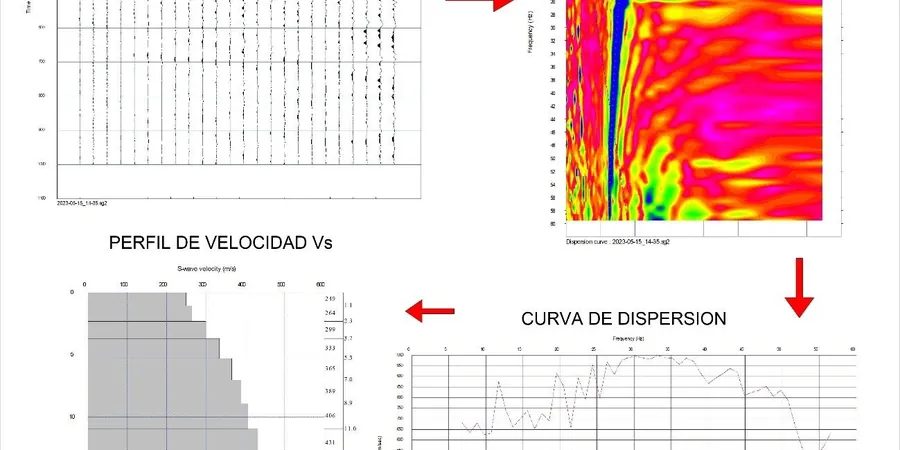
On a recent job near the port, we saw Vs100 values below 200 m/s in the first few metres before hitting a sharp impedance contrast at about 8 m depth. That kind of profile pushes you into a softer site class, which increases the design spectral acceleration. Our field setup uses a 24-channel seismograph with 4.5 Hz geophones and a sledgehammer source – enough energy to get usable fundamental-mode dispersion down to 30 m in most Drogheda soils. The raw data is processed with frequency-wavenumber analysis, and we check modal clarity before locking in the Vs profile. When deeper bedrock mapping is needed, seismic refraction adds P-wave control and helps resolve velocity inversions that surface-wave methods can miss.
MASW & VS30 Testing in Drogheda – Shear Wave Velocity Profiles
Technical reference image — Drogheda

Local considerations

We reviewed a four-storey apartment block on the north side of Drogheda where the original desk study assumed ground type B. The developer wanted to skip the site investigation. Our MASW survey showed Vs30 of 195 m/s – ground type C – and the structural engineer had to revise the lateral load system. That late change cost time but prevented an under-designed frame. The real risk here is not just classification error. Soft silts in the Boyne floodplain can amplify ground motion significantly. If you build on type D or E without knowing it, you are carrying a seismic risk that no one priced into the project. A half-day MASW survey eliminates the guesswork.

Need a geotechnical assessment?

Reply within 24h.

Email: contact@geotechnical-engineering.co

Technical parameters

ParameterTypical value
MethodMASW (Multichannel Analysis of Surface Waves)
Measured ParameterShear wave velocity (Vs) vs. depth
Depth of InvestigationUp to 30 m (extendable with longer spreads)
StandardASTM D4428 / Eurocode 8 (EN 1998-1:2004)
Site Classification OutputVS30 (m/s) → Eurocode 8 ground type A–E
Source TypeSledgehammer or weight drop on plate
Receiver Array24-channel, 4.5 Hz vertical geophones

Associated technical services

01

VS30 Site Classification

Single-array MASW survey with full dispersion analysis, inversion modelling, and a signed report giving your site class under Eurocode 8. Turnaround in three working days.

02

Combined MASW + Refraction

Paired surface-wave and P-wave refraction on the same spread. You get a Vs profile plus a tomographic P-wave section for bedrock depth and rippability, all from one field setup.

Applicable standards

Eurocode 8 (EN 1998-1:2004) – Seismic design and site classification, ASTM D4428 – Standard Test Methods for Crosshole Seismic Testing (adapted for surface-wave analysis), IS EN 1998-1 National Annex – Irish seismic zonation and design parameters

Frequently asked questions

How deep can MASW investigate in Drogheda soils?

With a standard 46 m spread and a sledgehammer source, we typically resolve Vs down to 25–30 m. In softer alluvial material along the Boyne, the surface-wave energy attenuates less and we sometimes see usable data below 30 m. For deeper targets we can extend the spread or use a heavier source.

What does VS30 mean for my Drogheda project?

VS30 is the time-averaged shear wave velocity in the top 30 metres. Eurocode 8 uses it to assign a ground type – A through E – which directly determines the design response spectrum. A lower VS30 puts you in a softer site class with higher spectral accelerations, meaning larger seismic loads on the structure.

How much does a MASW survey cost in Drogheda?

A standard single-array MASW survey with VS30 classification in Drogheda runs between €1.430 and €2.720, depending on access conditions, number of arrays, and whether you need a combined report with other methods. We quote fixed-price so you know the cost before we mobilise.

Can you do the survey when it is raining?

Light rain does not stop a MASW survey – the geophones are sealed and the equipment handles damp conditions fine. Heavy downpours that saturate the ground can reduce coupling quality, so we reschedule if the site turns to mud. We check the forecast and plan field days around Drogheda weather windows.
Location and service area

We serve projects across Drogheda and its metropolitan area.

View larger map